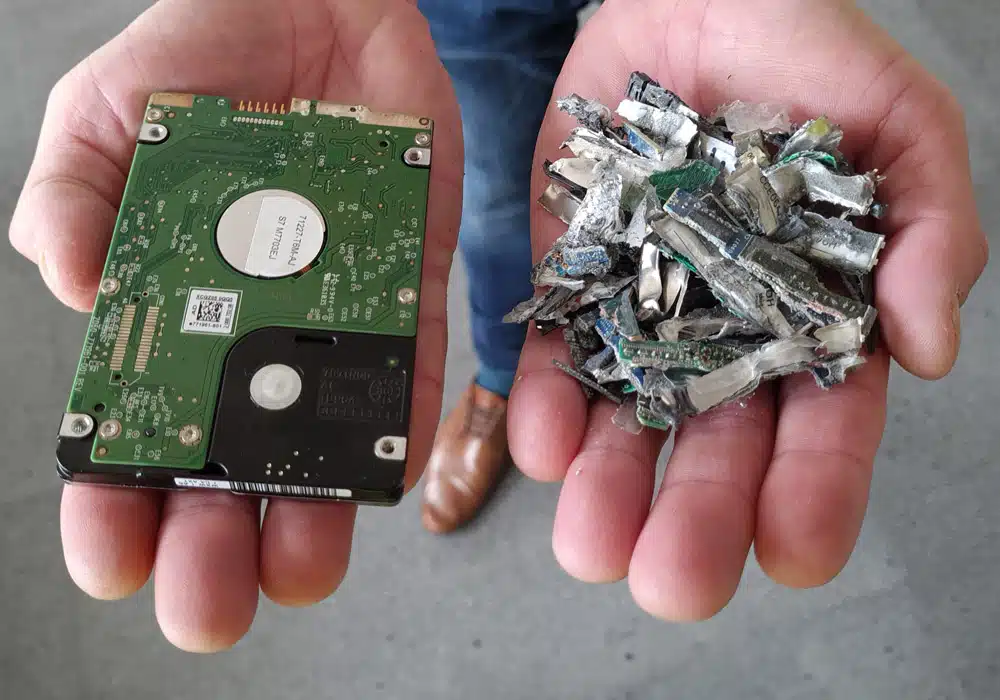
Data protection programmes tend to be strongest where the threat is visible. Firewalls, access controls, encryption at rest, and phishing training all target active attackers who probe live systems. However, the end of the lifecycle attracts far less investment. A retired disk carries the exact same information as a live one, yet it sits under none of the same controls.
Closing this gap requires applying the same discipline to hardware leaving your organisation as you apply to hardware inside it.
The Lifecycle Argument
Information security frameworks describe data as having a lifecycle: creation, storage, use, sharing, archiving, and destruction. Most organisations invest heavily in the first four stages while treating the last stage as an operational afterthought.
Auditors increasingly probe this imbalance because the final stage leaves data least protected and most concentrated. A single decommissioned database server often holds years of records in one place without monitoring or access logging. Applying secure hard disk disposal as a formal control brings that final stage under proper governance.
Classification Drives the Method
The right treatment for a disk depends on what was on it, which means classification has to happen before disposal is scheduled. A workable scheme needs only three or four tiers. Regulated and highly confidential data personal records, health information, payment details, legal material routes to physical destruction without exception. Internal business data of moderate sensitivity permits verified erasure followed by resale. Public or non-sensitive content can follow the standard erasure path with lighter documentation. Writing this down converts individual judgement into policy, which is what makes outcomes consistent across teams and defensible under review.
A single decommissioned database server may hold years of records in one place, with no monitoring and no access logging. Applying secure hard disk disposal as a formal control brings that stage under the same governance as the rest of the lifecycle.
Physical Security Before Collection
Disks awaiting disposal need the same protection as disks in production, and often get less. A retired drive sitting on a desk overnight, or in an unlocked cabinet accessible to cleaning staff and contractors, is exposed in a way no live system would be permitted to be. Practical controls are simple: a dedicated lockable cage or cabinet, access restricted to named individuals, a logbook recording every drive in and out, and a maximum holding period before collection. CCTV coverage of the area adds a further layer for organisations handling regulated data.
Verifying the Provider, Not Just the Promise
Under most data protection regimes the original organisation remains accountable for personal data even after handing it to a disposal contractor. That accountability requires documented due diligence. Ask for certification scope statements rather than logos, confirm which facility will process your assets, request the results of the provider’s most recent audit, and check whether processing is subcontracted. A written processing agreement should specify the sanitisation standard, retention of records, breach notification timelines and liability limits. A reputable ITAD company expects these questions and has the paperwork ready.
Reconciliation Is the Control That Catches Problems
The most useful check in the entire process is also the least glamorous. Count the drives out, count them in, and compare the numbers. Any discrepancy between your inventory and the provider’s receipt should trigger an immediate investigation rather than a note on a spreadsheet. Reconciliation at serial-number level catches the failure modes that summary counting misses a drive left behind in a server chassis, a unit that slipped out of a container, a serial recorded twice. This single control does more to protect against loss than any amount of contractual language.
Evidence That Survives Scrutiny
Documentation should be produced automatically by the process rather than assembled afterwards. Erasure software generates its own reports; destruction equipment logs serials as they are processed; collection systems produce timestamped manifests. Records built this way are consistent and hard to fabricate, which is precisely what gives them evidential weight. When serial-level certificates are generated as a by-product of the operation including the settlement report from any IT asset buyback the paperwork matches reality by construction rather than by careful transcription.
Common Failure Points
A few recurring mistakes account for most incidents. Storage inside multifunction printers, network appliances and point-of-sale terminals is routinely overlooked because those devices are not thought of as computers. Loan and test equipment returned by staff often skips the formal decommissioning route entirely. Drives pulled during hardware repairs get set aside and never enter the register. Assets held at branch offices or remote sites fall outside head-office processes. A disposal policy that only covers laptops and servers leaves all of these unaddressed.
Measuring Whether It Works
Like any control, disposal should be measured. Useful indicators include the average time between decommissioning and collection, the percentage of retired assets with a matching destruction or erasure certificate, the number of reconciliation discrepancies per project, and the volume of unidentified media discovered during sweeps. Tracking these over time shows whether the process is genuinely embedded or quietly eroding. A rising gap between decommissioning and collection, for instance, is an early warning that a new stockpile is forming.
The Underlying Principle
Everything above rests on one idea: a disk retains its data classification until that data is verifiably gone. Until the certificate exists, the drive should be handled, stored and tracked exactly as though it were still in a running system. Organisations that internalise this stop treating disposal as a facilities task and start treating it as a security function which is what it has been all along.
Bringing end of life hardware inside the security perimeter costs little and removes one of the few routes to your data that no technical control covers.
